
Battleland

Spending Our Way to Victory

  • Share
  • Read Later
Getty Images

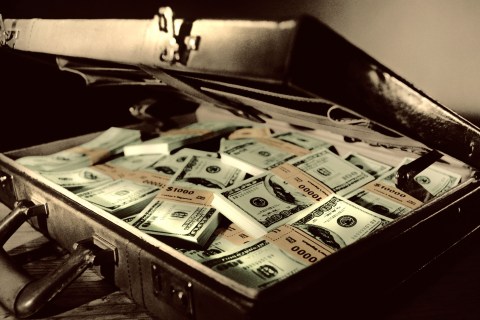
Your tax dollars at work.

Army Major Scott Hamilton was a civil affairs officer who deployed to Iraq in 2007-08 during the U.S. troop surge. He says he was unable to spend the Commander’s Emergency Response Program money as fast as his commanders wanted it to be spent.

“The amount of money they wanted to see spent was literally impossible to do,” he told the Combat Studies Institute at Fort Leavenworth, Kansas, in a December 2010 interview. “I would have had to have thrown money away by tens of thousands a day, and it just wasn’t possible.” Excerpts:

They had an obscene amount of CERP money that had to be spent and what they wanted me to do was spend it.

One of the things we know is that we can use money as a weapon system in our planning thought process, but we also know that like any weapon, it can be used to cause more damage than good.

I tried to spend money and develop projects as judiciously as I could, but there was still a lot of pressure to spend, spend, and spend. The amount of money they wanted to see spent was literally impossible to do. I would have had to have thrown money away by tens of thousands a day, and it just wasn’t possible.

The direction I got was going back to the stated intent; at the time, our theater commander GEN [David] Petraeus [the top U.S. commander in Iraq] had several  directional letters that he had put out, what he wanted to accomplish, how he wanted it approached, and I fell back to that.

That was where I got my planning guidance from. The battalion I was with and the brigade wanted money spent and the area pacified so they could get out.

War Story logo

I could understand that, but what I had to look at was judicious use of the nation’s resources and the long-term gain of establishing a long-term peace.  That’s what led me to the program in Salman Pak; if I showed up and started spending money, everything would be fine — as long as I was spending money.

When I stopped spending money, everybody would be even angrier than they were before we came in.

I approached it with long-term goals instead of short-term goals, and part of the problem was that I was there for a short-term.

The company commander said, “Look, just do what the battalion commander wants so we can get out of here,” and that was just the wrong answer.

I tried to meet the intent of GEN Petraeus and tried to apply the goals of the battalion commander, and had some successes. I never was able to make everybody happy, which is okay…

I uncovered several instances of criminal activity among the company that I was with; the reason I can’t expound on that very much is because these are ongoing investigations.

The criminal activity I refer to is the theft of money. I identified several persons who I suspected or knew were stealing money from contracts or taking payoffs and bribes, or seeking to take payoffs and bribes from contractors and representatives.

[Are you talking about U.S. or Iraqi?]

U.S., in my company. It was a very unpleasant situation, and it put us all in a bad spot. But, in the spirit of honesty and disclosure, I did the right thing and sought out the proper authorities and reported what I knew and suspected.

It was unpleasant and very unfortunate, and I very much regret being in that position, but it is a historical fact that what happened did happen, and I trust that Criminal Investigative Division (CID) is following the appropriate courses of action, but I don’t know what’s going on past the report.

I know some of the people who I reported have been investigated, found guilty, and imprisoned, but I don’t know about all of it.

7 comments
famulla5
famulla5

Stock index futures were little changed Friday following economic data out of China and Germany, though the benchmark S&P index, near five-year highs, was on track for its first weekly drop of the year. Data showed Chinese exports grew more than expected in January, while imports climbed 28.8 percent, highlighting robust domestic demand, while German data showed a 2012 surplus that was the nation's second highest in more than 60 years, an indication of the underlying strength of Europe's biggest economy. Comments from European Central Bank President Mario Draghi about the strength of the euro Thursday kindled concern about the euro zone economy and sent U.S. equities lower. U.S. economic data due out on Friday includes December international trade at 8:30 a.m. ET (1330 GMT) and wholesale inventories for December at 10:00 a.m. (1500 GMT). Economists poll expect a trade deficit of $46.0 billion versus a $48.7 billion deficit in November while inventories are expected to be up 0.4 percent versus a 0.6 percent increase in November. "Not enough to move the needle here and the norm of just about anything we put in front of investors this week," said Art Hogan, managing director of Lazard Capital Markets in New York. The S&P 500.SPXhas risen for five straight weeks and is up 5.8 percent for the year. Its advance was helped by legislators in Washington averting a series of automatic spending cuts and tax hikes earlier in the year, as well as better-than-expected corporate earnings and data that pointed to modest economic improvement but no immediate change in the Federal Reserve's stimulus plans. The index, hovering near five-year highs, has found it tougher to climb in recent days as investors await strong trading incentives to drive it further upward. "The market has gotten to a point where we are going to need a significant positive catalyst to take us through the next level of resistance, but the good news is we tested the new levels of support right around 1,504 on the S&P multiple times and we've held," said Hogan. S&P 500 futures were unchanged and slightly below fair value, a formula that evaluates pricing by taking into account interest rates, dividends and time to expiration on the contract. Dow Jones industrial average futures lost 13 points, and Nasdaq 100 futures added 6 points. LinkedIn Corp (LNKD.N) jumped 10.6 percent to $137.28 in premarket trading after announcing both blow-out quarterly profits and a bullish forecast for the new year that exceeded Wall Street's already lofty expectations. According to Thomson Reuters data through Thursday morning, of 317 companies in the S&P 500 that have reported earnings, 69 percent have exceeded analysts' expectations, above a 62 percent average since 1994 and 65 percent over the past four quarters. I thank you Firozali A.Mulla DBA

famulla5
famulla5

The problem is not that congress will recess; even if they stayed they would not resolve the budget problem. The crisis is a political crisis, the Republican Party has for the last 30 years been caterwauling endless about "cutting spending" and "cutting taxes" but in actual fact they have been increasing spending. It has been a very successful electoral strategy that has allowed the Republicans to dominate US politics for a generation; it delivered services to constituents while simultaneously cut their taxes. To do this of course required a "Borrow and Spend" fiscal strategy that drove up the debt and the deficit. This has amounted to a giant Republican check kiting scheme The contradiction is that the voters all like government spending but do not like taxes or debts or deficits. So long as the Republicans would keep the scheme going, all was well. Now however, the scheme is over, they can no longer keep up scam. They must cut programs, raise taxes, or reduce the deficit but they cannot do any those things. Cutting programs would anger most voters, raising taxes would anger the conservative base of the Republican Party, and with the first two they cannot do the third. The Republican Party has painted itself into an ideological corner where they can do nothing.What this means is that even if they were to stay in Washington and "earn their pay", they would be unable to compromise or negotiate. They are useless in Washington as they are outside. I thank you Firozali A.Mulla DBA

famulla5
famulla5

Wow, and all this times I though the housing collapse caused the banking crisis.
Silly me. "Why the Great Depression lasted so long has always been a great 
mystery, and because we never really knew the reason, we have always 
worried whether we would have another 10- to 15-year economic slump," 
said Ohanian, vice chair of UCLA's Department of Economics. "We found 
that a relapse isn't likely unless lawmakers gum up a recovery with 
ill-conceived stimulus policies." In an article in the August issue of the Journal of Political 
Economy, Ohanian and Cole blame specific anti-competition and pro-labour 
measures that Roosevelt promoted and signed into law June 16, 1933. "President Roosevelt believed that excessive competition was responsible for the Depression by reducing prices and wages, and by extension reducing employment and demand for goods and services," said Cole, also a UCLA professor of economics. "So he came up with a recovery
package that would be unimaginable today, allowing businesses in every 
industry to collude without the threat of antitrust prosecution and 
workers to demand salaries about 25 percent above where they ought to 
have been, given market forces. The economy was poised for a beautiful 
recovery, but that recovery was stalled by these misguided policies." Using data collected in 1929 by the Conference Board and the Bureau of Labour Statistics, Cole and Ohanian were able to establish average wages and prices across a range of industries just prior to the 
Depression. By adjusting for annual increases in productivity, they were
able to use the 1929 benchmark to figure out what prices and wages 
would have been during every year of the Depression had Roosevelt's 
policies not gone into effect. They then compared those figures with 
actual prices and wages as reflected in the Conference Board data. In the three years following the implementation of Roosevelt's policies, wages in 11 key industries averaged 25 percent higher than they otherwise would have done, the economists calculate. But 
unemployment was also 25 percent higher than it should have been, given 
gains in productivity. Meanwhile, prices across 19 industries averaged 23 percent above 
where they should have been, given the state of the economy. With goods 
and services that much harder for consumers to afford, demand stalled 
and the gross national product floundered at 27 percent below where it 
otherwise might have been If we double down on spending and spend another 6 trillion over the next 4 years will everything come up roses?  How to pay it back.  I know, we can default on the debt. Perfect, matches Americans today, when the pain gets to great run. I thank you Firozali A.Mulla DBA


Don_Bacon
Don_Bacon

"ongoing investigations" from activities five years ago -- that's a good one. By whom? There are also "ongoing investigations" in Afghanistan.

vstillwell
vstillwell

And we can't spend a dime on improving our schools or infrastructure in this country without some ideological blowhard screaming about the deficit. 

str8vision
str8vision

Trying to buy our way into their "hearts and minds" while dropping billions of dollars worth of munitions on their heads. Sorry about your two daughters and grandparents but just look at those pretty street signs! America's foreign policy at its best. On a brighter note, at least we neutralized all those WMDs.....