
Battleland

Why America’s Middle East Policy is Doomed

Getty Images

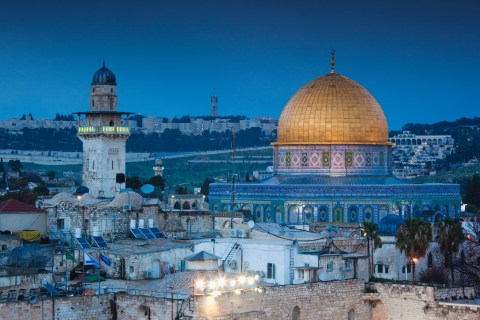
Jerusalem

The U.S. is pursuing a self-destructive grand strategy in the Middle East. It’s based on a pair of conflicting objectives, each bathed with high-toned rhetoric about promoting human rights and democracy:

– The pursuit of strategic economic advantage in the Arab states.

– Support of the consolidation of Israel.

That’s the view of retired U.S. ambassador to Saudi Arabia Chas Freeman, who shared it in a talk at the Washington-based Middle East Policy Council Jan. 16.

Without explicitly saying so, Freeman shows how the triangle of mismatches among our words and actions and the world those words and actions purport to deal with contradict the criteria of a sensible grand strategy.

He explains how interaction is sapping the moral authority of United States, and in so doing, it is dangerously reducing our capacity for independent action. Freeman’s line of argument is entirely consistent with the theories evolved by the late American strategist, Colonel John Boyd.

Freeman reveals why these self-inflicted mismatches are coming to a grand-strategic head, and — if left unaddressed — will blowback to America’s detriment.  There is no wasted verbiage in Freeman’s text — every paragraph is a clearly-written building block in a sweeping tour de force that is worthy of your careful study.

Grand Waffle in the Middle East

By Chas W. Freeman Jr.

Middle East Policy Council (MEPC)  –  January 16, 2013

Over the past half century or so the United States has pursued two main but disconnected objectives in West Asia and North Africa: on the one hand, Americans have sought strategic and economic advantage in the Arabian Peninsula, Persian Gulf, and Egypt; on the other, support for the consolidation of the Jewish settler state in Palestine.  These two objectives of U.S. policy in the Middle East have consistently taken precedence over the frequently professed American preference for democracy.

These objectives are politically contradictory.  They also draw their rationales from distinct moral universes.  U.S. relations with the Arab countries and Iran have been grounded almost entirely in unsentimental calculations of interest.  The American relationship with Israel, by contrast, has rested almost entirely on religious and emotional bonds.  This disconnect has precluded any grand strategy.

Full thing here.

3 comments
famulla5
famulla5

The US economyshrank 0.1 per cent at an annualised ratein the fourth quarter of 2012, rattling financial markets as one-off factors overwhelmed resilience in underlying demand. Much of the fall in gross domestic product was due to a big reversal in business inventories and a plunge in federal defence spending – both highly volatile – which each knocked 1.3 percentage points off growth. That suggests the underlying economy remains on a weak but stable growth path of 1-2 per cent. But the first reported decline in the US economy since the end of the recession in 2009 is a blow to confidence and highlights theuncertainty caused by fiscal policy. Market expectations were for a rise of 1.1 per cent. Consumption grew by 2.2 per cent at an annualised rate, adding 1.5 percentage points to growth, while business investment shrugged offfiscal cliffconcerns to rise by an annualised 8.4 per cent, and housing investment rose by an annualised 15.3 per cent.

Those numbers pointed to healthy underlying demand. “Frankly, this is the best looking contraction in GDP you’ll ever see,” said Paul Ashworth, chief US economist at Capital Economics in Toronto. “First-quarter GDP growth is going to be pretty weak because of the expiry of thepayroll tax cut. But there is nothing in these figures to change our view that US GDP growth will accelerate as this year goes on,” he said. The weakness came from two categories that are notorious for their volatility. Inventory growth – which over the long run should average out to roughly zero – had added 0.7 percentage points to gross domestic product in the third quarter anddefence spendinghad added 0.6 percentage That suggests a better guide to the underlying state of the economy is to look at the fourth quarter alongside third-quarter growth of 3.1 per cent – ending up with a mediocre, but steady, average of 1.5 per cent. “While inventories and government are what are most likely to catch the market’s eye it is hard to put a particularly positive spin on such a weak headline,” said David Semmens, senior US economist at Standard Chartered. “It will be important for Friday’s employment number to settle people’s nerves that this [the GDP figures] reflect the fiscal cliff concerns rather than a genuine stalling of the US economy.” There was an encouraging sign for Friday’s payrolls report when ADP, the private payrolls processing company, said on Wednesday morning that its survey found192,000 new jobs created in December. Job growth was particularly strong at small businesses, it reported. The effects of the protracted negotiations to avoid the fiscal cliff – as government spending cuts and tax rises were due to be triggered by year-end – were in evidence in a large rise of 6.8 per cent in disposable incomes in the fourth quarter. Given modest wage and jobs growth, the most likely explanation was that wealthier consumers brought income and capital gains forward into 2012, in the expectation that tax rates were about to rise. Points. Both were more than reversed in the following three months. This was expected as there are feuds with the immigration and the gun laws these have to be polished yet I thank you Firozali A.Mulla DBA

Don_Bacon
Don_Bacon

Obviously US Middle East policy HAS failed, based on the evidence. It's a matter of fact that the US has destabilized, or helped destabilize, every country on a line between India and the Med.  That includes Pakistan, Afghanistan Iran, Iraq, Syria and Lebanon. The continued support for Israel's crimes are also unpopular. As a result, the U.S. is more unpopular than ever in the middle East.

James Zogby, Jul 15, 2011, quote:

 In our survey of over 4,000 Arabs from six countries (Morocco, Egypt, Lebanon, Jordan, Saudi Arabia, and the UAE), we found that favorable attitudes toward the U.S. had declined sharply since our last poll (which had been conducted in 2009 after Obama's first 100 days in office).

U.S. favorability ratings, in most Arab countries, have now fallen to levels lower than they were in 2008, the last year of the Bush administration. In Morocco, for example, positive attitudes toward the United States went from 26 percent in 2008 to a high 55 percent in 2009. Today, they have fallen to 12 percent. The story was much the same in Egypt, where the U.S. rating went from 9 percent in 2008 to 30 percent in 2009, but has now plummeted to 5 percent in this year's survey.

A review of the poll's other results makes it clear that the continuing occupation of Palestinian land is seen by most Arabs as both the main "obstacle to peace and stability in the Middle East" and "the most important issue for the U.S. to address in order to improve its ties with the Arab World".
http://mideast.foreignpolicy.com/posts/2011/07/15/diminishing_goodwill_for_US_Middle_East_policy

DenisMacEoin
DenisMacEoin

Freeman calls Israel 'the Jewish settler state in Palestine'. There were Jewish settlers in the early days, before Israel was established, but they sure aren't settlers now, apart from the small numbers living in the West Bank settlements. Israel was built on resolutions by the League Nations and brought into existence by the United Nations. Wasn't the US a settler state on Indian land to start with? Weren't Australia and New Zealand settler states on Aboriginal and Maori land? Again, he says that US policies on the Middle East, including support for Israel,  'have consistently taken precedence over the frequently professed American preference for democracy'. What an obnoxious thing to say. Israel is a democracy in all respects: votes for all citizens, all adult citizens eligible to stand for parliament, free speech (probably more than in the US), laws that protect the rights of women, gays, and religious minorities – things not available in any other Middle Eastern country. If America doesn't stand up for the region's only true democracy, what on earth will it stand up for?


Read more: http://nation.time.com/2013/01/30/why-americas-middle-east-policy-is-doomed/#ixzz2JTrvp51a